
International Memorial Symposium
International Memorial Symposium on Jürgen Habermas
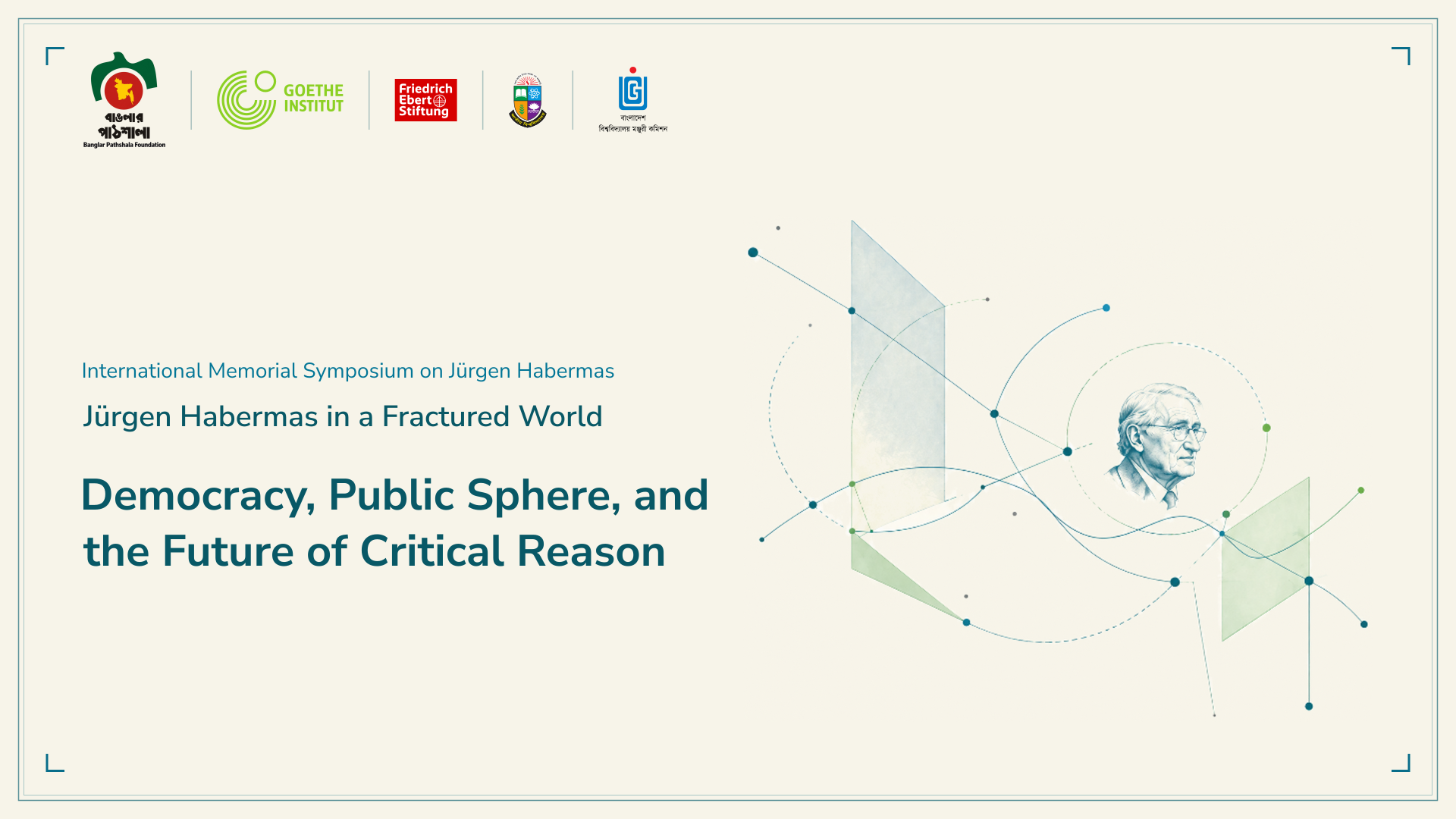
Jürgen Habermas in a Fractured World: Democracy, Public Sphere, and the Future of Critical Reason
Register to attend in-person
Registration is mandatory for in-person attendance due to limited capacity of the venue. Please sign up and wait for our confirmation email.
Register to attend in-personJoin online via Zoom
You can join online via Zoom without registration.
Join Zoom MeetingWhy this symposium matters
The memorial symposium revisits Jürgen Habermas’s contribution to democracy, communicative rationality, the public sphere, justice, and social freedom.
From a Bangladesh and Global South perspective, the programme connects Habermasian thought with democratic fragility, polarization, postcolonial experience, and human flourishing.
Four linked themes
- Communication: deliberation and democratic life.
- Critical Theory: power, lifeworld, and communicative distortion.
- Justice: dignity, legitimacy, and pluralism.
- Humanism: dialogue with Tagore and Lalon.
Symposium leadership
Symposium Adviser: Prof. Dr. A. I. Mahbub Uddin Ahmed and Prof. S. Aminul Islam (University of Dhaka). Convener: Ahmed Javed Chowdhury (Founder and Chairman, Banglar Pathshala Foundation).
Programme Schedule
All times are Bangladesh Time (UTC+6). Schedule may be adjusted by the organizers.
Registration / In-person check-in
Inaugural Session
Democracy, public sphere, and the future of critical reason. Chair and inaugural address by Ahmed Javed Chowdhury; welcome remarks by Frank Werner (Director, Goethe-Institut Bangladesh); remarks by Chief Guest Daniel Blum (Embassy of Germany in Dhaka) and Dr. Felix Gerdes (Friedrich-Ebert-Stiftung Bangladesh); inaugural keynote (in Bengali) by Prof. S. Aminul Islam; special guest Prof. Dr. A.S.M. Amanullah (VC, National University Bangladesh).
Tea / Coffee Break
Session I: Communication, Deliberation, and Democratic Fragility
Keynote by Prof. Dr. A. I. Mahbub Uddin Ahmed; papers by Dr. Lipon Mondal and Mainul Islam; discussants Md. Salah Uddin Al Faruque and Dr. Abdul Wohab; chair Prof. S. Aminul Islam.
Lunch Break
Session II: Adorno, Habermas, and Critical Theory — Communication, Power, and the Lifeworld
Papers by Shahidul Mamun and Md. Salah Uddin Al Faruque; discussants Dr. Lipon Mondal and Prof. S. Aminul Islam; chair Prof. Dr. A. I. Mahbub Uddin Ahmed.
Session III: Justice, Human Dignity, and Democratic Legitimacy
Keynote by Prof. Dr. Stefan Gosepath; guest reflections; papers by Dr. Md. Abdul Ghani, Ahmed Javed Chowdhury, and Dr. Abdul Wohab; discussant Prof. Dr. M Niaz Asadullah; chair Kabita Bose (Country Director, Plan International Bangladesh).
Tea Break
Session IV: Concluding Roundtable — Tagore, Lalon, and Habermas
Keynote by Prof. S. Aminul Islam; papers by Protik Bardhan and Ahmed Javed Chowdhury; discussants Prof. Dr. A. I. Mahbub Uddin Ahmed and Shahidul Mamun; chair Dr. Md. Abdul Ghani.
Tea Break
Session V: Special Evening International Keynote
Adorno, Habermas, and Critical Theory — keynote by Prof. Axel Honneth (Jack C. Weinstein Professor of the Humanities, Columbia University); chair Prof. Dr. A. I. Mahbub Uddin Ahmed.
Objectives & Institutional Vision
- Revisit and critically assess the intellectual legacy of Jürgen Habermas in the contemporary world.
- Explore the relevance of communicative rationality, deliberative democracy, and public sphere theory in societies experiencing democratic instability and polarization.
- Create dialogue between Critical Theory and Global South experiences, particularly Bangladesh and South Asia.
- Encourage young scholars, students, and intellectuals in Bangladesh to engage with contemporary democratic and philosophical debates.
- Foster long-term academic collaboration and intellectual exchange between Bangladeshi and international scholars, institutions, and research communities.
Beyond one event
The collaboration aims to support annual lecture series, reading groups, study circles, Bengali translation initiatives, international conferences, and youth forums on democracy and justice.
Participants
The symposium brings together approximately 50–60 invited participants, including university teachers, researchers, students, public intellectuals, civil society actors, journalists, and international scholars joining online via Zoom.
Among the participants, 30 carefully selected young researchers from the Faculty of Social Sciences, University of Dhaka — nurtured through the Young Researcher Initiative (YRI) of Banglar Pathshala Foundation — represent 15 different departments, bringing diverse disciplinary perspectives to the symposium.