
An international memorial symposium organized by Banglar Pathshala Foundation in collaboration with Goethe-Institut Bangladesh
International Memorial Symposium on Jürgen Habermas
Jürgen Habermas in a Fractured World
Democracy, Public Sphere, and the Future of Critical Reason
Thursday, 24 September 2026
Inaugural Session
- AJCAhmed Javed ChowdhuryCity University, Bangladesh · Inaugural Chair
- FWFrank WernerGoethe-Institut Bangladesh · Welcome Remarks
- DEGerman Ambassador / RepresentativeGerman Embassy in Bangladesh · Chief Guest
- SAIS. Aminul IslamUniversity of Dhaka · Introductory Reflection
- AAA.S.M. AmanullahNational University Bangladesh · Special Guest
Session I — Communication, Deliberation, and Democratic Fragility
- MAA. I. Mahbub Uddin AhmedUniversity of Dhaka · Keynote
- LMLipon MondalUniversity of Dhaka · Paper
- MIMainul IslamManikgonj Govt. Collage · Paper
- NBNurul Momen BhuiyanNational University · Special Guest
- SAIS. Aminul IslamUniversity of Dhaka · Chair
Session II — Adorno, Habermas, and Critical Theory
- AHAxel HonnethColumbia University · Keynote
- SMShahidul MamunPrachyanat School of Acting and Design · Paper
- SAFMd. Salah Uddin Al FaruquePaper Presenter
- LMLipon MondalUniversity of Dhaka · Discussant
- SAIS. Aminul IslamUniversity of Dhaka · Discussant
- MAA. I. Mahbub Uddin AhmedUniversity of Dhaka · Chair
Session III — Justice, Human Dignity, and Democratic Legitimacy
- SGStefan GosepathFreie Universität Berlin · Keynote
- AKSA.K.M. SalahuddinTimes University of Bangladesh · Guest of Honour
- MAGMd. Abdul GhaniSUST · Paper
- AJCAhmed Javed ChowdhuryCity University · Paper
- MAHMd. Aoulad HosenNational University · Special Guest
- MAA. I. Mahbub Uddin AhmedUniversity of Dhaka · Discussant
- SHSara HossainBangladesh Supreme Court · Chair
Session IV — Tagore, Lalon, and Habermas
- SAIS. Aminul IslamUniversity of Dhaka · Keynote
- PBProtik BardhanPaper Presenter
- RMRamendu MazumderDiscussant
- AASAbdulla Abu SayeedDiscussant
- AJCAhmed Javed ChowdhuryConcluding Remarks
- MGMeghna GuhathakurtaIndependent Researcher · Chair
Jürgen Habermas in a Fractured World
Democracy, Public Sphere, and the Future of Critical Reason
Background and Rationale
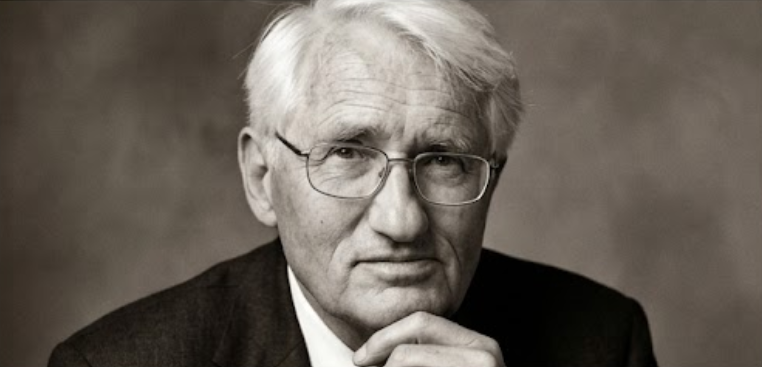
The passing of Professor Jürgen Habermas on 14 March 2026 marked the end of one of the most remarkable intellectual eras in modern social and political thought. As a foremost representative of Critical Theory and the Frankfurt School tradition, Habermas shaped global conversations on democracy, communicative rationality, deliberative politics, constitutionalism, ethics, the public sphere, and social justice.
The symposium revisits Habermas’s intellectual contributions in light of democratic fragility, polarization, communicative distortions, rising authoritarian tendencies, crises of public reasoning, and growing distrust in institutions. It brings these questions into a Bangladesh-based inquiry concerned with communication, domination, democracy, justice, and human flourishing.
The symposium also seeks to create an intellectual bridge between Critical Theory and South Asian traditions of dialogue, ethics, humanism, and public reasoning, including reflections on Rabindranath Tagore and broader traditions of democratic imagination in Bengal and South Asia.
Intellectual Rationale & Thematic Progression
The four thematic sessions form a cumulative intellectual inquiry rather than a collection of independent papers. They move from the conditions of communication to the structure of the lifeworld, from the public sphere to questions of justice and democratic legitimacy, and finally toward a dialogue between Habermasian critical theory and Bengali traditions of humanism.
I · Communication
Communication and deliberation as foundations of democratic life, including questions of communicative rationality, the public sphere, media, and democratic fragility.
II · Lifeworld
Critical Theory, power, the lifeworld, communicative distortion, linguistic asymmetry, and the conditions under which communicative action may emerge.
III · Justice
Justice, human dignity, democratic legitimacy, and the material and substantive conditions necessary for meaningful participation.
Objectives
- Revisit and critically assess the intellectual legacy of Jürgen Habermas in the contemporary world.
- Explore the relevance of communicative rationality, deliberative democracy, and public sphere theory in societies experiencing democratic instability and polarization.
- Create dialogue between Critical Theory and Global South experiences, particularly Bangladesh and South Asia.
- Encourage young scholars, students, and intellectuals in Bangladesh to engage with contemporary democratic and philosophical debates.
- Foster long-term academic collaboration and intellectual exchange between Bangladeshi and international scholars, institutions, and research communities.
Structure of the Symposium
- One inaugural session
- Four thematic plenary sessions
- Keynote lectures
- Paper presentations
- Panel discussions
- Open discussion and audience engagement
- Hybrid participation through Zoom for international speakers
The symposium will include both English and Bengali sessions to make key ideas accessible to wider audiences, especially students and emerging scholars in Bangladesh.
International Dimension
The symposium aims to invite selected international scholars working on Critical Theory, democracy, justice, public sphere, social philosophy, and Global South politics. Invited scholars may participate online via Zoom.
Expected Participants & Audience
Selected students, young researchers, university teachers, and scholars interested in Habermas and critical social theory, including university students, faculty members, public intellectuals, selected journalists, civil society actors, and international scholars participating online.
Expected participation: Approximately 70–100 participants.
Institutional Vision
This symposium is envisioned as the beginning of a broader collaboration between Banglar Pathshala Foundation and Goethe-Institut Bangladesh in the fields of Critical Theory, democracy and public reasoning, study circles and lecture series, youth intellectual engagement, and South Asian social and political thought.
Annual Lecture Series
Future intellectual engagements around critical theory, democracy, justice, and public reasoning.
Reading Groups & Study Circles
Longer-term opportunities for sustained discussion and youth intellectual engagement.
International Exchange
Translation initiatives, international conferences, and youth forums on democracy and justice.
About the Organizers
The cultural institute of the Federal Republic of Germany, committed to promoting international cultural exchange, dialogue, language, and intellectual engagement through arts, culture, philosophy, literature, and academic collaboration.
Founded in 2009, Banglar Pathshala Foundation is an independent youth-led intellectual and educational initiative in Bangladesh aiming to promote Critical Thinking within the Public Sphere of the World. It organizes seminars, conferences, lecture series, study circles, and public discussions on democracy, justice, development, philosophy, political economy, and social transformation in Bangladesh, South Asia, and beyond.
Concluding Note
This symposium is envisioned not merely as a tribute to the life and work of Professor Jürgen Habermas, but as an invitation to continue the conversations that defined his intellectual legacy. By bringing together distinguished scholars from Bangladesh and abroad, the symposium seeks to strengthen democratic dialogue, deepen critical inquiry, and cultivate enduring academic collaboration across cultures.
In doing so, it hopes to contribute—however modestly—to a richer public sphere and a more humane future, both within Bangladesh and beyond.