
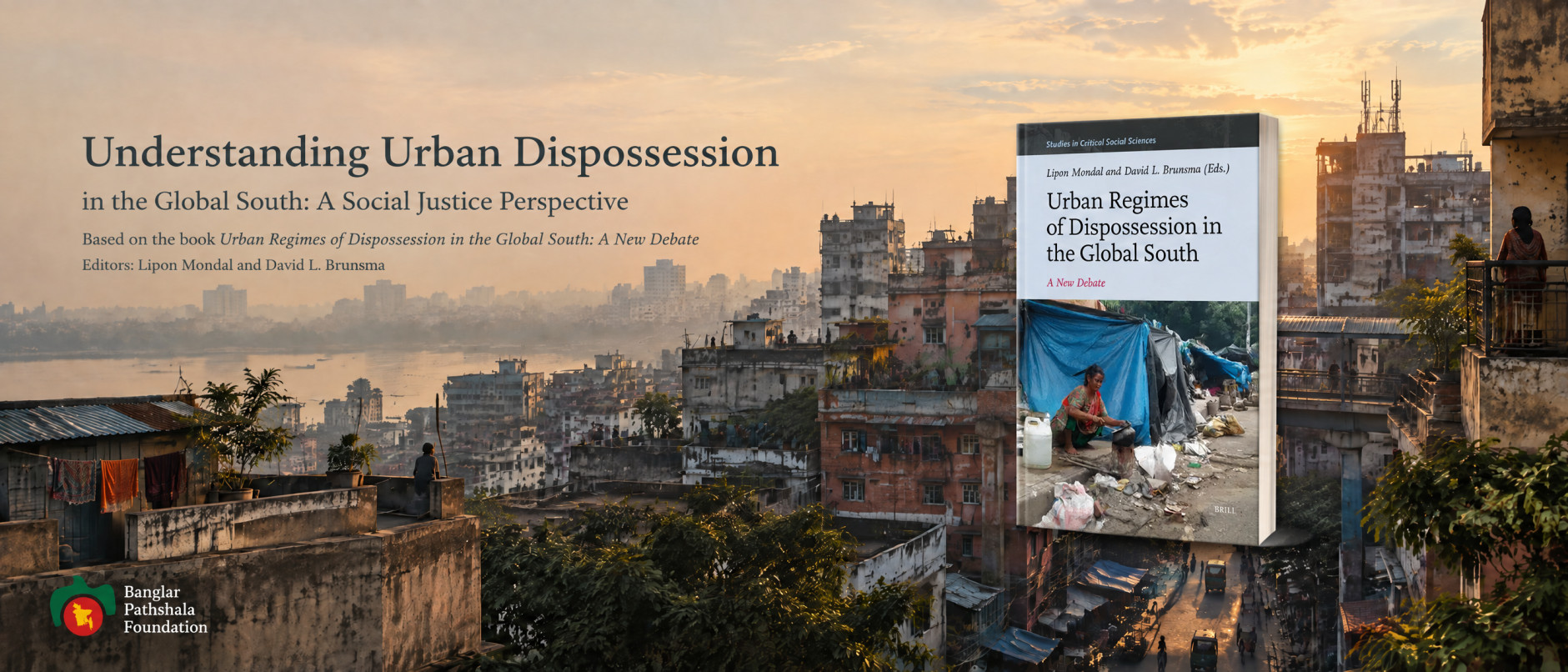
Understanding Urban Dispossession in the Global South
✦ Program
The programme follows the book's three-part analytical architecture, closing with a roundtable
| # | Session Theme | Focus |
|---|---|---|
| 1 |
Formal Regimes of Dispossession
How law, planning, development projects, and state institutions facilitate urban dispossession
|
Case studies: Honduras, Nigeria, India |
| 2 |
Informal Regimes of Dispossession
Informality, patronage, coercion, criminalization, and everyday governance
|
Case studies: Bangladesh, Brazil, Uganda |
| 3 |
Subaltern Regimes of Dispossession
Urban struggles, resistance, social movements, and alternative urban politics
|
Case studies: Lebanon, Brazil |
| 4 |
Closing Roundtable
Future research directions, urban policy, and democratic urban governance
|
Open discussion |
Guiding Discussion Questions
- How has urban dispossession become a dominant urban (dis)order experienced by much of the urban population in the Global South?
- How do the three regimes of dispossession interact to produce and reproduce urban marginality, injustice, and inequality?
- In what ways do dispossessed communities resist dispossession and reclaim urban space?
- What lessons does the volume offer for understanding Bangladesh's rapidly urbanizing cities?
- How do the volume's insights contribute to building democratic, inclusive, and just urban societies?
About the Symposium
Introducing a major new scholarly contribution to Bangladesh's academic and policy community
The Banglar Pathshala Foundation is pleased to organize a day-long international symposium centered around this book — introducing it to academics, researchers, students, policymakers, urban planners, civil society leaders, and development practitioners in Bangladesh, while fostering critical dialogue on one of the defining questions of contemporary urbanization: how are cities concurrently making development and producing dispossession in the Global South?
Rather than functioning as a conventional book launch, the symposium creates an interdisciplinary forum where scholars from sociology, economics, political science, law, anthropology, geography, architecture, urban planning, and development studies can critically engage with the book's theoretical innovations and empirical findings, and explore their implications for Bangladesh and the wider Global South.
✦ Editors & Contributors
Eighteen scholars bring empirical and theoretical perspectives from across the Global South
✦ Concept Note & Objectives
Summarized and reorganized from the Concept Note shared for this project
Rapid urbanization is one of the defining characteristics of the twenty-first century. Across Asia, Africa, and Latin America, cities are expanding at unprecedented rates, intensifying struggles over land, housing, livelihoods, infrastructure, and citizenship. While dispossession has long been studied within agrarian political economy, far less attention has gone to how it unfolds specifically in urban contexts.
The book is particularly timely for Bangladesh, where rapid urbanization, informal settlements, climate-induced migration, land acquisition, and housing inequality continue to reshape the social and spatial landscape of Dhaka and other cities.